General and language learning theory, my own preferences as a learner, and my experiences as a learner and teacher all influence my beliefs about the nature of learning and teaching.
I regard interactivity in classrooms as crucial because, through engagement of learners together in focused activities, I have witnessed, read evidence of, and experienced greater learner interest and improved retention. Besides, if learners are passive recipients, it is difficult to see how they are going to develop domain-specific, generic, cognitive or linguistic skills.
Fortunately, social constructivism currently enjoys considerable favour in educational circles, and this encourages teachers to plan for active, collaborative learning. Outcomes-based education generally promotes a constructivist view of learning and results in more student-centredness. Moreover, in the language learning arena, the popularity of the communicative approach also results in an emphasis on student-student interaction.
Another advantage of an interactive, student-centred approach is that teachers have more freedom to monitor and listen to learners. This can have benefits in terms of informing the teacher about the progress of learners and their mood, and whether divergences from lesson plans are required.
Saying this, I still think that direct instruction has its place as an efficient means to convey information to large groups when self-aware learners are armed with effective learning strategies and can adjust to didactic teaching in order to internalise content knowledge. Behaviourism too offers a partial explanation of learning. Repetitive practice has its place, particularly with the development of psychomotor skills. Repetitive learning can involve understanding as well as habit formation, for example in the learning of Chinese characters and drills in language learning are beneficial for pronunciation.
As a teacher and trainer, I am conscious of my own learning style, but careful not to impose it on others. To accommodate a group of learners’ preferences, I initially adopted a balanced activities approach, i.e. varying the means and modes of instruction over time to satisfy some learners some of the time. Nowadays, I am able to employ a range of differentiation strategies which is more efficient. It is also my practice to conduct learner training so that students can eventually differentiate for themselves.
With regard to establishing a positive environment with and between learners, I conduct activities designed for this purpose. I also endeavour to act unaffectedly, manage behaviour in a consistent and fair manner, and observe learner reactions carefully.
During initial training, I believe that new teachers need to be exposed to the theory and research findings underpinning the pedagogical guidance that they receive, and to be invited to question that guidance by reflecting on personal learning experiences.
However, clear direction at this stage is, I consider, warranted. In my experience, teachers starting out on their careers look for straightforward recommendations from trainers on how to teach. Lesson frameworks and an assortment of immediately applicable teaching techniques constitute a ‘survival kit’ to meet their short-term needs as educators. They also need opportunities to develop the micro-skills of classroom management, e.g., giving clear instructions. Without these skills, teaching can be inefficient, disorganised and they may lose student confidence.
I also think that lesson observations, teaching journals and reflective assignments can help to circumvent any propensity towards prescriptivism in their teaching. For example, situated discussion following lesson observations in which the observer carefully evaluates the success of the teaching by reference to achievement of intended learning outcomes rather than strict adherence to a teaching recipe. This, I believe, can help new teachers to become more reflective and flexible classroom practitioners and to pay more attention to the learners rather than their own teaching performances. In the longer term, or for more experienced teachers, I believe it is advantageous if they are supported to continue their professional development through additional workshops to increase their methodological options, and through their own educational enquiries via, e.g., action research projects.
My reply to this question is yes, in readiness for unanticipated behaviours. Knowledge of behaviour management approaches and skills in reinforcing positive behaviour are valuable additions to the competencies of university teaching practitioners, not only school teachers. This conclusion is based on my experience of assisting a department at a British university that was faced with student behavioural issues. Read on for the full story…
While working as an educational developer in a Centre for Learning and Teaching, I made an intervention at the behest of the university’s International Foundation Programme (IFP).
The IFP at that university is a well-established alternative route onto degree programmes. In recent times, however, lecturers on the programme had reported an increase in behavioural issues amongst students. The IFP leadership team contacted my Centre for assistance. Since I had previous experience in the secondary education sector, in which classroom behaviour management (CBM) has a long heritage, I was the educational developer nominated to provide support.
My first step was to familiarise with the IFP itself. These are its characteristics:
It provides a pathway to undergraduate degree courses for students without GCE A Levels;
the 1-year programme includes subject studies, academic English, statistics and study skills;
students are globally recruited
lecturers are mostly drawn from relevant faculties; and,
it is often students’ first experience of living away from home.
I met programme managers to negotiate the objectives of my support and a way forward that was agreeable to them. We also discussed their initial ideas on the severity of the issue and probable causes. This was speculative though, so better data was needed. Together we worked out a process by which managers could identify the types and seriousness of problems, I could inform the teaching team of alternatives in behaviour management, and a concerted and consistent way forward could be devised and implemented that would align with relevant university policies.
This is the process that was agreed upon:
Workshop 1: Approaches to classroom behaviour management
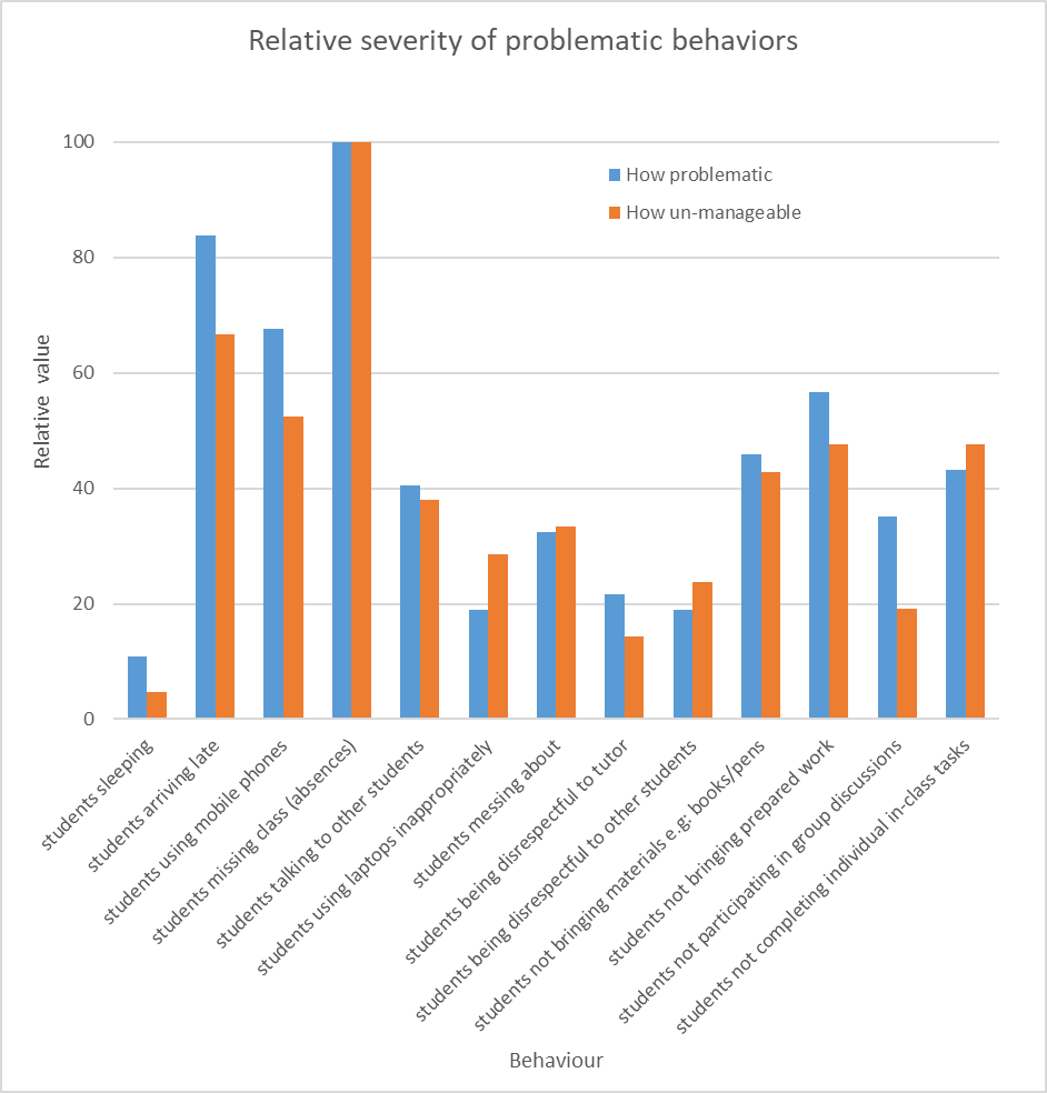
Needs analysis: Staff survey of behavioural issues and their perceived relative severity
Workshop 2: Interactive demonstration of behaviour management techniques
Compilation and distribution of university regulations and a CBM reading list
Workshop 3: Long term planning
Consolidation and review
The intended outcome of Workshop 1 was for IFP colleagues to be able to articulate the various established approaches to CBM according to educational literature. For Workshop 2, it was for IFP colleagues to evaluate and select reactive techniques to modify student behaviour “live” during lectures and seminars. For Workshop 3, it was for the whole IFC team to identify and plan preventative longer-term measures in an integrated, consensual approach.
In Workshop 1, I presented four CBM approaches: systemic, psychodynamic, behavioural and humanistic (Hart, 2010).
One of the managers created a staff survey on types of problematic behaviour and their perceived relative seriousness. This survey was administered between Workshops 1 and 2 with a very high response rate. The results are presented in the chart below.
To achieve the main aim of Workshop 2, I made use of my network across the university to invite a guest presenter, a professor from the faculty of education. She has expertise in CBM and agreed to demonstrate a selection of techniques that may be employed when students transgress classroom rules. This was performed as a role play with IFC lecturers performing the parts of students who displayed problematic behaviours. It was a memorable, hilarious experience with a serious point, and evaluative discussion on the techniques following the role play was lively and interesting.
I also summarised University policies on student conduct and supplied links to reference documents and key readings on behaviour management.
Workshop 3 was the culmination of my intervention. It was a longer session using group discussion and flipcharts to negotiate and generate a set of preventative measures, standards and guidelines, aligned to institutional policy, that would be administered consistently by all teaching staff in future.
Consolidation after Workshop 3 was undertaken by the IFC leadership team. They compiled the decisions and presented everything formally in time for implementation in the next academic year. The new CBM approach and strategies would be evaluated later.
I will next provide a rationale for addressing the IFP’s request for assistance in the manner that I did.
Educational developers perform a range of roles. One of them is to respond to ad hoc requests for support such as the one from IFP that I have described. In this kind of situation, I believe it is important to offer a bespoke service that meets needs in that specific learning-teaching environment.
Conducting learning needs diagnoses was already embedded in my practice during my earlier career as a teacher of English for Academic Purposes and as an educational consultant in the secondary sector. It has carried over into my work as an educational developer. I am aware of a range of ways to gather information prior to interventions or facilitations. In the case of IFP, it was through a meeting with the management team and a staff survey.
The first workshop was an opportunity to show IFP lecturers that there is a body of work on the topic of behaviour management. The fact that there are several approaches and a range of strategies available reassured them to some extent. It was also an opportunity for me to learn their current responses to perceived behaviour issues, which it transpired were diverse and not consistent between staff members.
Knowing that the final outcomes of the intervention would only start to bear fruit in the following academic year, I considered it important to introduce a range of classroom techniques to the lecturers to help them reinforce appropriate behaviours in the short term. Such techniques are reactive in nature and do not address underlying causes of the behaviours. However, they could enable teachers to partially re-establish more productive learning environments to the benefit of those students who were eager to study and who were being distracted by less cooperative learners. To this end, Workshop 2 demonstrated those techniques and invited IFP lecturers to select those techniques that they thought were viable for use.
Workshop 3 only took place after IFP staff had had ample time to read and absorb the provided policy documents, academic readings and staff survey results. Thus informed, there was an efficiency about the final session and in a short time, planning documents were created that summarised the intended direction and the measures to be taken in readiness for behaviour management of the next cohort.
In hindsight, it seems that my intervention had a significant limitation. I was focused more on staff perspectives rather than students’. A more comprehensive approach on my part would have included investigation into the reasons for, or causes of, learners’ conduct during lessons. There may have been many factors affecting their behaviours related to, e.g., programme quality, lecturers’ demeanours, cultural backgrounds, personal external factors, homesickness, etc. Saying this, it is feasible that students joining the IFP in the following academic year would have dissimilar behaviours and influences on behaviour. Any conclusions drawn by asking current learners may not have been that applicable to future learners. Still, I think it was an omission, and I encouraged IFP managers to pay close attention not only to student feedback on the quality of course provision, but also to conduct confidential interviews to gain insight into learners’ attitudes and circumstances.
Below is the list of references that I recommended to IFP lecturers and managers:
Bennet, T. (2010). The behaviour guru: behaviour management solutions for teachers. Continuum.
Brown, S., Armstrong, S. & Thompson, G. (1998). Motivating students. Kogan Page.
Canter, L. (2010). Assertive discipline: Positive behaviour management for today’s classroom. Solution Tree Press.
Cowley, S. (2010). Getting the buggers to behave. Continuum.
Cox, S. & Heames, R. (1999). Managing the pressures in teaching. Falmer Press.
Department for Education and Science [DfES] (1989). Discipline in schools. The Elton report. London: HMSO.
Hart, R. (2010). Classroom behaviour management: educational psychologists’ views on effective practice. Emotional and Behavioural Difficulties, Vol. 15, No. 4, 353-371.
Rogers, B. (2011). Classroom behaviour: A practical guide to effective teaching, behaviour management and colleague support. Sage.
With a shorter attention span, kids may find it difficult to sit through a lesson in front of a computer screen. What are some tips on keeping students engaged and involved?
Poorly designed virtual lessons that leave learners passive for long periods invite students to become distracted. Young learners’ chances of remaining focused are higher when lesson topics are intriguing yet relatable to their world experience, when learning tasks are challenging yet achievable with guidance, and when they are on task for a high proportion of the lessons.
To make sure of the latter, my lessons at Young Philosophers are divided into short phases which are all active in nature. Even when the philosophical topic is first introduced through a short, animated story or other kind of stimulus, I make it an interactive presentation by posing questions to involve learners and ensure comprehension. After analysing the stimulus, students brainstorm more abstract questions and vote for the questions that will be discussed deeply. This element of choice is also important to keep them motivated and interested.
As students become more comfortable with my P4C (Philosophy for Children) lesson framework, I intervene more selectively to prompt higher quality discussion between learners and provide quality feedback on thinking skills development. So again, the emphasis is on them having ownership of the process. I want to encourage them to feel like partners in learning.
Interaction can be a challenge in virtual settings. How can teachers help and make sure students understand the concepts taught in lessons?
That the lessons are virtual actually has an advantage in that I can listen in to discussions more easily, particularly when students are in break-out groups. It also helps that class size is limited to six students. There are enough learners to have a range of perspectives in discussions but few enough for me to monitor and help individuals if they have miscomprehensions that are barriers to learning.
This is Philosophy, mind you, so the primary activity is exploring complex concepts more deeply through dialogue and reflection. Concepts like ‘personal identity’ do not have universally agreed definitions, which is why they have been debated for centuries. If I were to simply explain such a concept and then test for a ‘correct’ understanding, this would not help learners to develop their rationality and imagination.
However, when discussing a concept such as ‘identity’, learners may unintentionally equivocate, i.e. shift between definitions of the term, which causes confusion in discussions. In this situation, I highlight what is happening and underline the importance of agreeing on which meaning is being examined. This is an example of me equipping them with philosophical tools.
What are some essential elements of effective virtual learning?
As with face-to-face teaching, it is crucial for teachers to know learners well enough to tailor learning experiences. For this reason, I welcome all new students in a one-to-one online session to understand more about them as people and the reasons for their interest in Philosophy.
I also provide a balance between more guided learning and independent exploration. Some virtual learning takes place real time in my online lessons using a webinar application, and some takes place asynchronously with students exploring recommended online resources or completing individual tasks at their own pace before or after lessons.
There are numerous methods or recipes for eLearning and indeed I follow a framework derived from inquiry-based learning. However, the success of any method’s implementation depends on the skills of the tutor. As a trained teacher with thirty years’ experience, I am able to apply my P4C framework expertly, but I am also confident enough to diverge from it according to learners’ responses in lessons. This reactive style is a hallmark of professional teaching.
Why is learning philosophical skills important for children today?
There is research evidence that P4C courses have a positive impact on analytical skills, creativity, and even language ability and maths. By learning philosophical skills in their pre-teens, learners can be better prepared for the challenges of upper secondary school studies.
Less pragmatically, students have a chance to apply these skills to explore concepts of interest to all human beings, for example Fairness, Happiness, or Beauty. These topics are not commonly addressed directly in upper primary or lower secondary school curricula but, as Socrates said, “The unexamined life is not worth living.”
How does philosophical thinking help prepare students for today’s world?
By following my courses, students can develop their capacity for calm and rational discussion which, in my opinion, is much needed in today’s world. An example of a disposition that is expected in Young Philosophers is the willingness to change opinions when it becomes clear that another student’s viewpoint is more logical and better evidenced.
I hope this shows that Philosophy is not the same as arguing or debating. It is not meant to be adversarial. Instead, it is cooperating with others so that all parties can move towards clearer understandings of complex ideas.
Young Philosophers seeks to nurture reasonableness, in all its meanings.
 Jackdaw Learning & Teaching